


How to Use AI Responsibly for Cambridge Exam Preparation

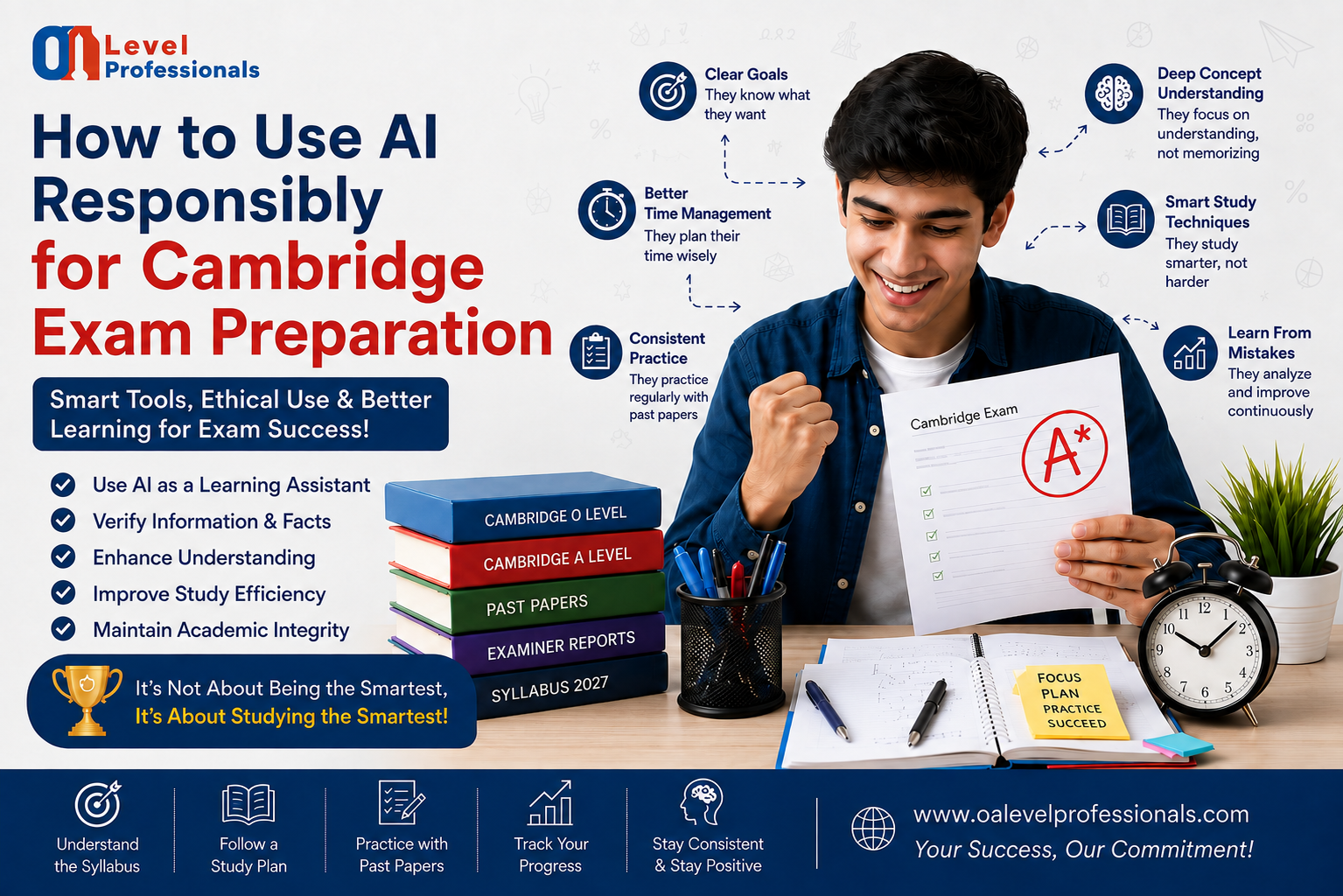
Artificial Intelligence (AI) has transformed the way students learn, revise, and prepare for examinations. From explaining difficult concepts to creating study plans and generating practice questions, AI has become a valuable learning companion for many Cambridge O Level and A Level students. However, while AI offers numerous benefits, it should be used responsibly. The goal is to improve your understanding and independent learning—not to replace your own thinking or effort.
One of the best ways to use AI is as a personal learning assistant. If you find a topic confusing, AI can explain it in simpler language, provide examples, and answer follow-up questions. This is especially helpful for subjects such as Mathematics, Biology, Chemistry, Physics, Economics, and English, where understanding concepts is more important than memorising facts. AI can help break down complex topics into smaller, easier-to-understand sections.
AI is also useful for creating personalised study plans. Every student has different strengths, weaknesses, and learning speeds. AI can help you organise your revision schedule by dividing the syllabus into manageable daily or weekly goals. A structured timetable allows you to stay consistent and reduces the stress of last-minute preparation.
Another effective use of AI is practising exam-style questions. AI can generate quizzes, topic-based questions, and mock exam scenarios to help reinforce your understanding. After answering these questions, you can compare your responses with mark schemes and identify areas that need improvement. This type of active learning strengthens both knowledge and exam technique.
Despite these advantages, students should avoid depending entirely on AI for their studies. Simply copying AI-generated answers without understanding them does not improve learning. Cambridge examinations are designed to assess your ability to analyse, evaluate, solve problems, and apply knowledge independently. During the actual exam, AI will not be available, so your success depends on your own understanding and preparation.
It is also important to verify the information provided by AI. While AI is a powerful educational tool, it may occasionally provide incomplete or inaccurate answers. Always cross-check important facts, formulas, and definitions with your Cambridge textbooks, official syllabus, teacher guidance, and trusted educational resources. Combining AI with reliable study materials ensures accurate and effective learning.
Students should also use AI ethically. Never use AI to complete assignments dishonestly, generate coursework that must be your own work, or engage in any form of academic misconduct. Cambridge values honesty, originality, and independent thinking. Responsible use of AI means using it as a support tool rather than a shortcut.
AI can also help improve productivity. It can summarise lengthy chapters, create flashcards, explain difficult vocabulary, and suggest revision techniques that match your learning style. These features save time and allow students to focus more on practising and understanding important concepts.
Ultimately, AI is most effective when combined with traditional study methods. Reading textbooks, attending classes, solving past papers, reviewing examiner reports, and asking teachers for guidance remain essential parts of Cambridge exam preparation. AI should complement these methods—not replace them.
At O/A Levels Professionals, we encourage students to embrace technology while maintaining academic integrity and independent learning. By using AI responsibly alongside consistent revision, past paper practice, and expert guidance, you can prepare confidently for Cambridge O Level and A Level examinations and develop skills that will benefit you far beyond the exam hall.
FAQ’S
Yes. AI can explain concepts, create study plans, generate practice questions, summarise topics, and help you organise your revision more effectively.
Yes, as long as you use it responsibly as a learning aid and not as a replacement for your own understanding or independent work.
No. Always verify important information using your Cambridge textbooks, official syllabus, teacher guidance, and trusted educational resources.
No. AI is a support tool. Your textbooks, teachers, classroom learning, and past paper practice remain the most important resources for exam success.
AI can create personalised study timetables, explain difficult topics, generate quizzes, produce flashcards, and suggest effective revision techniques.
AI can help you understand concepts and improve your writing, but you should never submit AI-generated work as your own if independent work is required.
Yes. AI can create topic-based questions and mock exams that help reinforce learning, but students should also practise official Cambridge past papers.
Overdependence on AI can weaken independent thinking, problem-solving skills, and exam readiness because AI will not be available during the actual examination.
Here’s a professional 4-line paragraph you can use as an internal link in your blog:
Feeling overwhelmed by the Cambridge syllabus is completely normal, but the right approach can make preparation much easier. Read our “How to Start Preparing for Cambridge Exams Without Feeling Overwhelmed” to learn practical strategies for creating a study plan, staying organised, and building confidence from day one.
Contact Us:
Phone No:+92-3167742629
Email: info@oalevelprofessionals.com
Instagram:https://www.instagram.com/oalevelprofessionals/
Facebook: https://web.facebook.com/OALevelProfessionals
Tiktok:https://www.tiktok.com/@oalevelprofessionals