


How to Use AI Without Losing Your Ability to Think

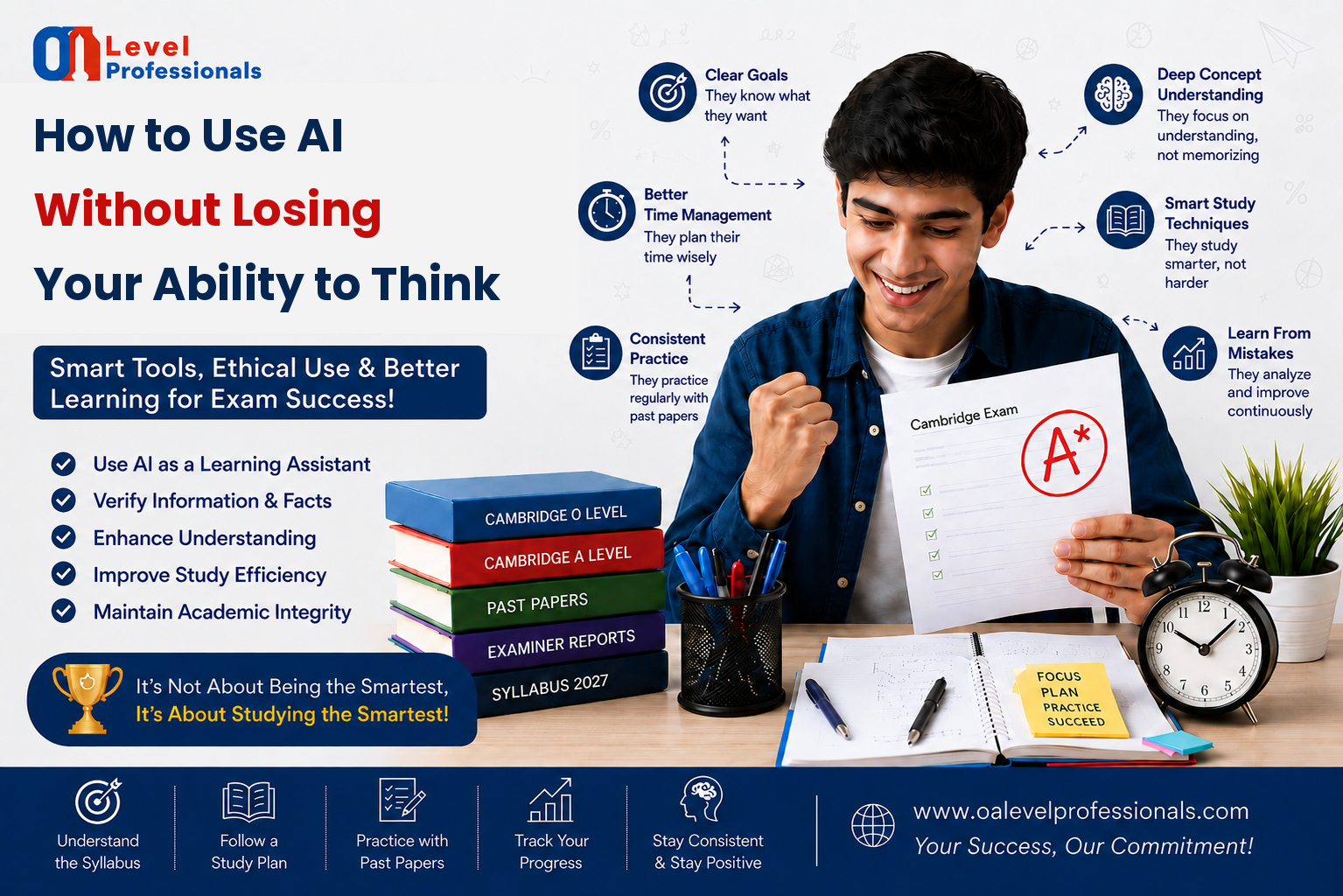
Artificial intelligence is becoming an increasingly common part of education. Students can use AI to explain difficult concepts, generate practice questions, organise revision, and explore new ideas within seconds. While these tools can make learning faster and more convenient, there is an important question every Cambridge O Level and A Level student should ask: Am I using AI to learn, or am I using it to think for me?
The real value of education comes from developing your own ability to understand information, solve problems, make decisions, and communicate ideas. If students rely on AI for every answer, they may complete their work faster but gradually become less confident in solving problems independently. The goal should therefore be to use AI as a learning assistant rather than a replacement for your own thinking.
One of the best ways to use AI responsibly is to try solving a problem yourself first. Before asking AI for an answer, spend a few minutes thinking about the question, recalling what you have learned, and attempting a solution. Even if your answer is incomplete, the effort helps your brain develop problem-solving skills. You can then use AI to identify mistakes or explain where your reasoning could be improved.
AI is particularly useful when you ask it to provide hints instead of complete answers. For example, if you are struggling with a Mathematics problem, ask for the first step or a clue rather than the final solution. For an essay question, ask AI to help you evaluate your argument instead of writing the entire essay. This keeps you actively involved in the learning process.
Another valuable technique is asking AI to explain the same concept in different ways. If a textbook explanation is difficult, you can request a simpler explanation, an example, an analogy, or a step-by-step breakdown. After understanding the concept, close the AI tool and explain it yourself. If you can teach the concept without assistance, you are much more likely to have genuinely understood it.
Students should also develop the habit of questioning AI-generated information. AI can produce convincing answers that may contain errors. Rather than accepting every response as fact, compare important information with your textbook, teacher’s explanation, syllabus, or reliable educational sources. Learning to verify information is an important skill in the modern digital world.
Another important rule is to protect your academic independence. If an assignment, coursework, or assessment is supposed to represent your own work, students should follow their school’s and Cambridge’s applicable academic-integrity requirements. Copying AI-generated answers may produce a polished result, but it does not demonstrate your actual knowledge or abilities.
AI can also make revision more interactive. Students can use it to generate quizzes, test their knowledge, create flashcards, identify weak areas, or simulate questions. However, after using AI for practice, students should continue with genuine Cambridge past papers and review official mark schemes to develop authentic examination skills.
Ultimately, the best students in the AI era will not necessarily be those who use AI the most. They will be the students who know when to use it, how to question it, and when to put it away and think independently.
At O/A Levels Professionals, we encourage students to embrace technology while protecting the most important skill of all—the ability to think for yourself. Use AI to make your learning better, not to make your thinking unnecessary.
FAQ’S
AI itself does not make students less intelligent. However, depending on AI for every answer without attempting to think independently can reduce opportunities to develop problem-solving and critical-thinking skills.
Try solving problems independently before using AI. Ask for hints, explanations, or feedback instead of immediately requesting complete answers.
No. First attempt the question yourself. If you are stuck, use AI to understand the concept or receive a hint, then complete the problem independently.
Yes, when used correctly. Students can ask AI to challenge their arguments, provide alternative viewpoints, identify weaknesses, or ask follow-up questions.
Explanations and hints are generally more useful for learning because they encourage you to understand the process rather than simply copy the result.
Compare important information with reliable textbooks, official educational resources, your teacher’s guidance, and relevant syllabus information. AI-generated information should not automatically be treated as correct.
Yes. AI can support revision by creating quizzes, explaining concepts, generating practice exercises, and helping students identify weak areas. It should complement—not replace—past papers and other official preparation resources.
Follow your school’s and Cambridge’s applicable academic-integrity rules. If an assignment is intended to demonstrate your own work, you should not simply submit AI-generated content as your own.
AI is rapidly changing the way students learn, revise, and prepare for Cambridge examinations. Understanding how to use these tools responsibly can give students an advantage without compromising genuine learning. Read our “AI, Education & Cambridge: What Every Student Needs to Know “guide to discover practical ways AI can support your studies, revision, and future academic journey.
Call uS oN : 03167742629Contact Us:
Email: info@oalevelprofessionals.com
Instagram:https://www.instagram.com/oalevelprofessionals/
Facebook: https://web.facebook.com/OALevelProfessionals
Tiktok:https://www.tiktok.com/@oalevelprofessionals