


AI, Education & Cambridge: What Every Student Needs to Know

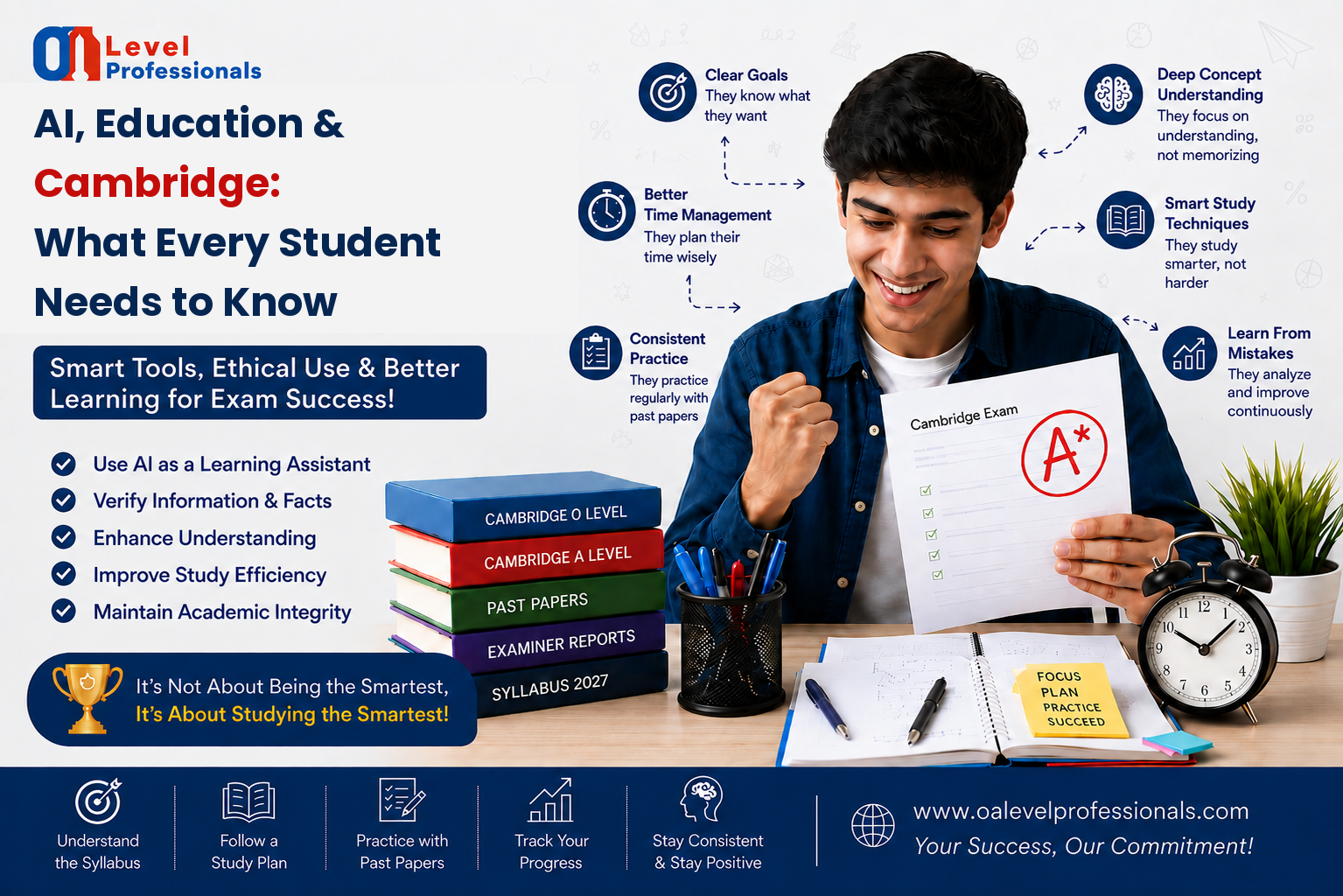
Artificial intelligence is changing the way students learn, revise, research, and prepare for examinations. For Cambridge O Level and A Level students, AI can be a powerful learning assistant when used correctly—but it should never replace genuine understanding, independent thinking, or academic integrity. As technology continues to develop, knowing how to use AI responsibly is becoming an important skill for modern students.
One of the biggest advantages of AI is its ability to provide personalised learning support. Students can use AI tools to ask questions, request simpler explanations, generate practice questions, or explore difficult concepts from different perspectives. If a student does not understand a topic from a textbook or classroom explanation, AI can provide another explanation that may make the concept easier to understand.
However, students should remember that AI-generated information is not always correct. Artificial intelligence can sometimes produce inaccurate, outdated, or misleading information. This is why students should verify important facts using reliable textbooks, official Cambridge resources, teacher guidance, and trusted educational sources. Learning to question information rather than accepting everything automatically is an essential part of becoming an effective learner.
AI can also be useful for revision. Students can ask an AI tool to create quizzes, flashcards, topic-based questions, or revision exercises. These resources can help students identify weak areas and practise concepts before attempting Cambridge past papers. However, students should still complete genuine past papers and study official mark schemes to understand the actual examination requirements.
Another important use of AI is improving understanding rather than simply producing answers. For example, instead of asking AI to solve an entire problem and copying the response, students can ask for hints, explanations, or step-by-step guidance. This approach encourages active learning and allows students to develop their own problem-solving abilities.
Academic integrity is one of the most important considerations when using AI. Students should never use AI to complete work that they are expected to produce independently or present AI-generated content as their own. The purpose of education is not simply to obtain an answer—it is to develop knowledge, reasoning, communication, creativity, and independent thinking.
AI also cannot replace teachers. An experienced teacher can understand a student’s individual weaknesses, recognise confusion, provide personalised feedback, and guide learning based on classroom and examination requirements. AI should therefore be viewed as an additional tool that supports teachers and students rather than replacing them.
The future will require students to develop skills that go beyond memorising information. Critical thinking, research skills, communication, creativity, problem-solving, digital literacy, and the ability to evaluate information will become increasingly valuable. Cambridge students who learn how to combine these skills with strong subject knowledge can be better prepared for university and future careers.
Ultimately, the smartest way to use AI is to make it part of your learning process—not the replacement for it. Use AI to understand, practise, question, and improve, but always think for yourself.
At O/A Levels Professionals, we encourage students to embrace useful technology while maintaining strong academic standards. With responsible AI use, effective study techniques, expert guidance, and consistent practice, Cambridge students can prepare for both their examinations and a rapidly changing future.
FAQ’S
Yes, AI can be used as a learning support tool, provided students use it responsibly and follow the academic integrity requirements that apply to their work and examinations.
AI can help explain difficult concepts, create practice questions, generate revision exercises, provide study ideas, and support students when they are struggling with a topic.
No. AI can provide useful assistance, but teachers offer personalised guidance, feedback, subject expertise, and an understanding of a student’s individual learning needs.
No. AI can sometimes provide incorrect or outdated information. Students should verify important information using reliable educational resources and teacher guidance.
Yes. Students can use AI to create quizzes, practise concepts, review topics, and understand difficult material. However, official past papers and mark schemes should remain an essential part of exam preparation.
Students should follow their school’s and Cambridge’s applicable academic-integrity requirements. Work that is expected to be independently produced should not simply be generated by AI and submitted as the student’s own.
Try solving a problem yourself first. Use AI for explanations, hints, feedback, or alternative approaches rather than immediately asking it to provide the complete answer.
Important skills include critical thinking, problem-solving, communication, research, creativity, digital literacy, independent learning, and the ability to evaluate information.
AI can be a powerful learning tool, but students should use it to support their thinking—not replace it. Learn how to use AI for explanations, practice, feedback, and revision while maintaining your critical-thinking skills. Read our “How to Use AI Without Losing Your Ability to Think “guide to discover smart and responsible ways to use AI in your Cambridge journey.
Call uS oN : 03167742629Contact Us:
Email: info@oalevelprofessionals.com
Instagram:https://www.instagram.com/oalevelprofessionals/
Facebook: https://web.facebook.com/OALevelProfessionals
Tiktok:https://www.tiktok.com/@oalevelprofessionals